
Usage-based pricing can support customer lifetime value by allowing customers to adjust consumption according to their needs rather than maintaining fixed subscriptions. This flexibility may reduce cancellations, encourage continued engagement, and create opportunities for revenue expansion as customers increase their use of a product or service.
webinar
How Usage-Based Pricing Is Reshaping Revenue Models
From Fixed Subscriptions to Value-Based Monetization
Traditional subscription models are being challenged as businesses seek more flexible ways to align pricing with customer value. Usage-based pricing offers an alternative, allowing companies to connect revenue directly to product consumption, customer adoption, and measurable outcomes.
In this episode of If Prices Could Talk, Adam Howatson, CEO of LogiSense, joins Tracy Dent and Pete Morelli of Holden Advisors to discuss how usage-based pricing is reshaping revenue models and creating new opportunities for growth.
Drawing on decades of experience in enterprise monetization and pricing strategy, the conversation explores why companies are rethinking fixed subscriptions, how hybrid and outcome-based pricing models are evolving, and what it takes to operationalize more sophisticated pricing strategies.
From reducing barriers to customer adoption to improving retention and customer lifetime value, discover how businesses can build pricing models that balance revenue predictability with greater commercial flexibility.
What You'll Learn
- Why traditional subscription models are being challenged: Understand how changing customer expectations and economic pressures are accelerating demand for more flexible pricing.
- How usage-based pricing aligns revenue with customer value: Explore how consumption-based models connect what customers pay with the products and services they use.
- The evolution toward outcome-based pricing: Learn how businesses are moving from simple consumption metrics toward pricing based on successful customer outcomes.
- Why hybrid pricing models matter: Discover how minimum commitments and variable usage charges can balance predictable revenue with customer flexibility.
- How flexible pricing supports retention and growth: Understand how consumption-based models can reduce adoption barriers, shorten sales cycles, and create opportunities for account expansion.
- The importance of usage data and billing infrastructure: Explore why accurate data collection, mediation, and rating are essential for supporting complex monetization models.
Listen to the conversation to learn how the right pricing strategy can become a competitive advantage while creating a more transparent and valuable customer experience.
Continue learning
Usage Economy Summit
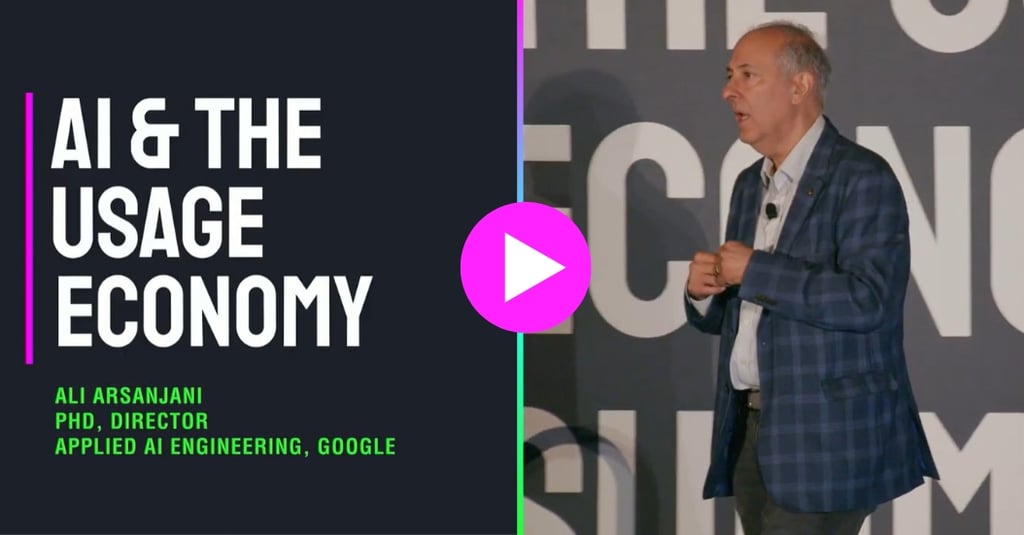
AI, Infrastructure, and the Usage Economy
Dr. Ali Arsanjani shares Google’s vision for the future of agentic AI, highlighting how it is reshaping pricing models and what SaaS and enterprise leaders must do to thrive in a usage-driven economy.
Speak with an Expert
Turn Usage-Based Pricing into Revenue Growth
Speak with a LogiSense expert to explore how you can transform consumption into revenue.
FAQ
How does usage-based pricing affect customer lifetime value?
What is the difference between usage-based pricing and outcome-based pricing?
Usage-based pricing charges customers according to measurable consumption, such as transactions, API calls, or data usage. Outcome-based pricing goes further by connecting charges to a successful result, such as a resolved customer support request. Both models aim to align pricing more closely with customer value, but outcome-based pricing focuses on results rather than activity.
Can usage-based pricing shorten enterprise sales cycles?
Usage-based pricing can reduce initial purchasing barriers by allowing customers to access products without committing to significant upfront expenditures. Customers can evaluate the service through actual usage before making larger commercial commitments, potentially accelerating adoption and strengthening subsequent pricing negotiations.
Why is pricing simplicity important in complex usage-based models?
Complex usage-based models can incorporate multiple consumption metrics, discounts, and contractual conditions. However, customers need to understand how their charges are calculated. Simple, transparent pricing structures help businesses communicate value, improve predictability, and avoid creating unnecessary friction in the customer experience.